Conservative Catholics Demand that Massachusetts Gov. Maura Healey Be Excommunicated for Signing Late-Term Abortion Bill Into Law
Healey pledged to keep abortion safe, legal and accessible in Massachusetts for as long as she remains governor, drawing praise from abortion rights advocates.

By Gary Gately
Thousands of conservative Catholics have demanded that the Catholic governor of Massachusetts, Maura T. Healey, be excommunicated for signing into law a measure allowing abortions up until birth.
The presidents of the prominent national conservative political organizations CatholicVote and Catholics for Catholics, along with the conservative Catholic website LifeSiteNews, called on the state’s bishops Wednesday to excommunicate Healey, a Democrat, for signing the legislation. It eliminates the state’s existing restrictions on abortions beyond 24 weeks, instead stating that an abortion may be performed “based on the professional judgment of the physician.”
LifeSiteNews also launched an online petition Wednesday urging Boston Archbishop Richard G. Henning to excommunicate Healey for having “sinned gravely against God by legalizing the killing of babies until birth.” More than 17,500 people had signed the petition as of early Thursday afternoon.
The state’s four bishops had already condemned the measure as “gravely immoral” after the Massachusetts House of Representatives approved it on July 22. (The state Senate passed the measure on July 31.) And on Tuesday, Archbishop Henning said in an X post: “The passage and signing of a bill radically expanding abortion in the Commonwealth of Massachusetts is a grave offense against the sanctity and dignity of every person.”
Anti-abortion groups, some conservative Catholic bishops and numerous Catholic commentators also condemned the measure, making Massachusetts the 11th state to allow abortions up until birth, and denounced Healey for signing it.
But Denise Murphy McGraw, the national co-chair of the progressive Catholics Vote Common Good, said in an email to The Catholic Observer Thursday morning that the organization “rejects the Trump-aligned Catholic right’s reflexive calls to excommunicate elected officials whenever they take an action these organizations oppose.”
“That same outrage is never directed at leaders who carry out the death penalty, launch illegal wars, cut food assistance for children, or deny health care to seniors and veterans — all actions that violate the dignity of human life,” Murphy McGraw said. “Late-term abortions are tragic; they should never be exploited as a fundraising opportunity or a media stunt by failing right-wing organizations.”
The Massachusetts Catholic Conference, the public policy arm of the Catholic Church in the state, and the Archdiocese of Boston did not immediately respond to requests for comment. Nor did Catholics for Choice, which advocates for abortion rights and cites surveys showing about 6 in 10 U.S. Catholics say abortion should be legal in most or all cases.
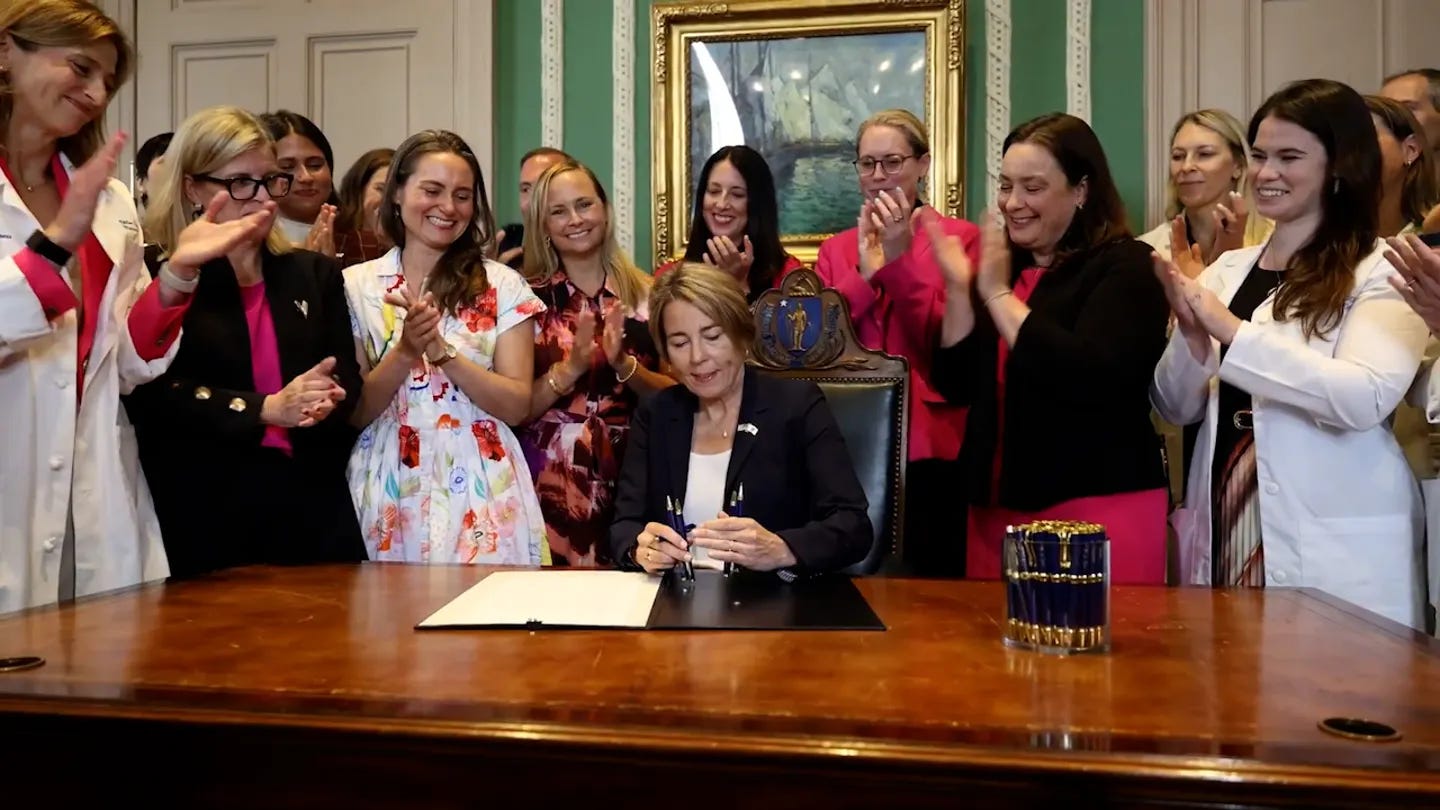
The “Prioritizing Patient Access to Care Act,” signed by Healey Monday, removes restrictions that had allowed abortions after 24 weeks of gestation only in life-threatening situations for the pregnant woman or fetus. Healey said the law, which takes effect in 90 days, would ensure that women suffering serious pregnancy complications could receive care from medical providers they know and trust in the state.
"We've heard so many stories — stories that are filled with a lot of pain and anguish and heartache and a lot of trauma,” Healey said as she signed the measure, drawing applause from abortion rights advocates, lawmakers and physicians who stood alongside her.
“We're signing this law today so that new patients, people we won't know or won't meet, will be able to get the care that they need in Massachusetts. Instead of being able to rely on the doctors they knew and trusted at home, they were forced to travel hundreds of miles and pay out of their pockets while navigating unimaginable grief,” the governor added. “That should never happen in Massachusetts.”
Since the U.S. Supreme Court’s 2022 decision overturning Roe v. Wade, which had established a constitutional right to an abortion for nearly a half-century, Healey said, “protecting abortion access and reproductive health care has been under fire” from Republicans who seek to roll back abortion rights.
Healey, who is running for a second term in November, pledged that abortion would remain safe, legal and accessible in the state as long as she is governor.
She said 1 in 3 women in the U.S. live in a state with an abortion ban, adding: “We believe health care decisions should be made between women and their doctors, not politicians.”
At the signing ceremony, Kate Dineen and her husband, Alex Lawton, recalled learning nearly 33 weeks into her pregnancy in 2021 that their son, Teddy, had suffered a catastrophic stroke in utero.
Dineen said the couple was told their son would either die or survive with potentially devastating medical complications. His diagnosis did not qualify for an exception under Massachusetts law, and the couple traveled to the Washington, D.C., area for an abortion.
“Upon learning of the prognosis, I asked, ‘What are my options?’ And I will never forget the response: ‘You may still be able to explore termination if you’re able to travel,’” Dineen said. “Travel where? We were standing in our kitchen in Boston, just less than a mile from some of the best hospitals in the country.”
Dineen said her doctor’s “highly capable hands were tied by Massachusetts state law.”
The Massachusetts Health and Hospital Association and several prominent healthcare systems in the state sent a joint letter to House Speaker Ron Mariano supporting the abortion bill in mid-July. They said it would “remove arbitrary restrictions” on abortion care after 24 weeks of pregnancy and “empower physicians to use their professional judgment and clinical expertise to make decisions in the best interest of their patients.”
CatholicVote President: Not Excommunicating Healey Sends Wrong Message
Kelsey Reinhardt, the president of CatholicVote — whose support helped Donald J. Trump win the Catholic vote in 2024 by the largest margin of any presidential candidate in more than a half-century — expressed gratitude to Massachusetts bishops for condemning the law. But Reinhardt made clear that she believes that Church teachings necessitate that the bishops publicly state that Healey incurred automatic excommunication when she signed the legislation.
In a statement Wednesday, Reinhardt said: “When a Catholic governor signs legislation permitting abortion until birth, celebrates that signing publicly, and receives no response from her bishops beyond a press statement, the lesson absorbed by the faithful is not subtle. It is: This is tolerable and within the range of what a Catholic may do. The line is somewhere further along, and we do not yet know where it is. That lesson is wrong. And it is being taught every day that it goes uncorrected.”
Reinhardt pointed to St. Pope John Paul II’s 1995 encyclical Evangelium Vitae (“Gospel of Life”), which unequivocally condemns abortion, stating: “No circumstance, no purpose, no law whatsoever can ever make licit an act which is intrinsically illicit, since it is contrary to the Law of God which is written in every human heart, knowable by reason itself, and proclaimed by the Church.”
Reinhardt also invoked canon law mandating automatic, or latae sententiae, excommunication for anyone who “procures a completed abortion” as well as for “accomplices” without whom the abortion would not have been committed.
“A governor who signs legislation into law is not a bystander: she is the necessary final act of a legislative process that cannot take legal effect without her,” Reinhardt said. “Without her signature, the abortions that [the Massachusetts abortion law] enables would not occur. She is not merely complicit in a general cultural sense, but in the precise canonical meaning of the term… The Church’s law was written to account for exactly this kind of cooperation.”
Excommunication is the most serious sanction in the Catholic Church’s Code of Canon Law. It does not mean a person stops being Catholic — the Church teaches that baptism as a Catholic cannot be undone — but does formally exclude excommunicated Catholics from participating in the life of the Church unless they repent and are reconciled. Excommunicated Catholics may not receive any of the sacraments, including the Eucharist, confession or anointing of the sick. They may not exercise any Church ministry or office. If they die while excommunicated and without reconciliation, they are not entitled to a Catholic funeral or burial rite, though pastoral discretion can be applied in particular circumstances.
Reinhardt acknowledged that “excommunication is a drastic step that may be misunderstood and will provoke political backlash.”
She noted that excommunication is classified in canon law as a “medicinal penalty” whose purpose “is not retribution, but conversion.” It is necessary for the spiritual well-being of Healey, Reinhardt suggested, saying the governor “is a Catholic in a state of grave sin” who “has publicly and now legislatively cooperated in the destruction of innocent human life.”
John Yep, the president of the conservative political organization Catholics for Catholics, urged Archbishop Henning in a letter Wednesday to excommunicate Healey “until she publicly repents of this sin that cries out to heaven.”
“Cheers of demons rejoicing over this horrible offense against God”
“The Governor of your state signed into law the ‘right’ for a woman to murder a child up until birth,” Yep wrote. “This is a living baby who cries and screams for help as the blade of the murderer chops their organs into pieces and packages them for sale. The cheers coming from that room as Governor Healey signed this death sentence into law were drowned out by the cheers of demons rejoicing over this horrible offense against God.”
While “innocent children have received the death penalty,” Yep wrote, “the Church has remained extremely passive.”
“Publishing a public statement opposing this abortion proposal just days before it became law is good,” he added, “but it does not confront this evil with the strength and conviction it demands…. You are a successor of the Apostles, entrusted with administering the Canon Law of the Catholic Church. These laws, whose goal is the ‘salvation of souls,’ leave no question as to what your course of action needs to be.”
Yep also wrote that Healey, who made history when she became the nation’s first openly lesbian governor with her election in 2022, “causes great scandal through her public same-sex relationship with another woman.”
Citing canon law, Yep also urged Henning to deny Healey Holy Communion.
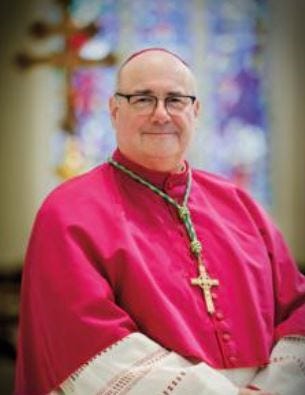
But Dominique Lee, president and CEO of Planned Parenthood League of Massachusetts, countered that the law “brings us one step closer to realizing true reproductive freedom in Massachusetts.”
“At a time when many states are banning abortion and endangering the lives of pregnant people, Massachusetts lawmakers are strengthening reproductive rights and access to compassionate care,” Lee said. “I’m grateful to Governor Healey for continuing to champion reproductive freedom and promptly signing this legislation…. to fully trust patients and their doctors with medical decisions later in pregnancy.”
Church unwavering in opposition to abortion
The Catholic Church has been unwavering in condemning abortion, including in the Vatican’s April 2024 “Dignitas Infinita” (“Infinite Dignity”), which listed abortion among “grave violations of human dignity.”
Pope Francis had gone so far as calling abortion “murder.” And ahead of the 2024 elections, the USCCB released a voters guide calling the threat of abortion “our preeminent priority because it directly attacks our most vulnerable and voiceless brothers and sisters.”
Pope Leo XIV has repeatedly reaffirmed the Church’s opposition to abortion, including in his historic address to the Spanish Parliament in June.
“The defense of human life is neither a partisan issue nor a confessional interest; it is a goal of civilization,” he told Spain’s lawmakers, even as they weighed a constitutional amendment to guarantee the right to an abortion, as France has done. “Every human life must be recognized and safeguarded from conception to its natural end, in every circumstance of its existence,” the leader of the 1.4 billion-member Catholic Church said.
Echoing Pope Francis’ condemnation of a “throwaway culture,” Leo asked: “Can a community that casts into the shadows the unborn child, the elderly, the sick, those who suffer in silence, or those who depend entirely on the care of others be called fully just?”
But less than five months after being elected the first U.S.-born pope, Leo weighed in on a high-profile abortion dispute that divided the American Catholic Church by pointing out contradictions in the meaning of “pro-life.”
Leo was responding to a reporter’s question in late September 2025 about Chicago Cardinal Blase Cupich’s decision to bestow upon Senator Dick Durbin a “Lifetime Achievement Award” for his work on behalf of immigrants despite the Illinois Democrat’s longstanding support for abortion rights.
“I think it is very important to look at the overall work that a senator has done during, if I am not mistaken, 40 years of service in the United States Senate,” Leo said. “I understand the difficulty and the tensions, but I think, as I myself have spoken in the past, it’s important to look at the many issues related to the teaching of the Church. Someone who says, ‘I’m against abortion but is in favor of the death penalty’ is not really pro-life. Someone who says, ‘I’m against abortion, but I’m in agreement with the inhuman treatment of immigrants in the United States,’ I don’t know if that’s pro-life. So they’re very complex issues.”
Cupich had been a close adviser to Pope Francis, who, while upholding Church teaching against abortion, also criticized U.S. bishops for politicizing the issue. Some conservative bishops had demanded that Catholic politicians, including former President Joe Biden, be denied Communion over their support for abortion rights.
Biden met with Francis several times and told reporters in 2021 that the Argentine Jesuit pontiff had told him he was “a good Catholic” who should continue receiving Communion.
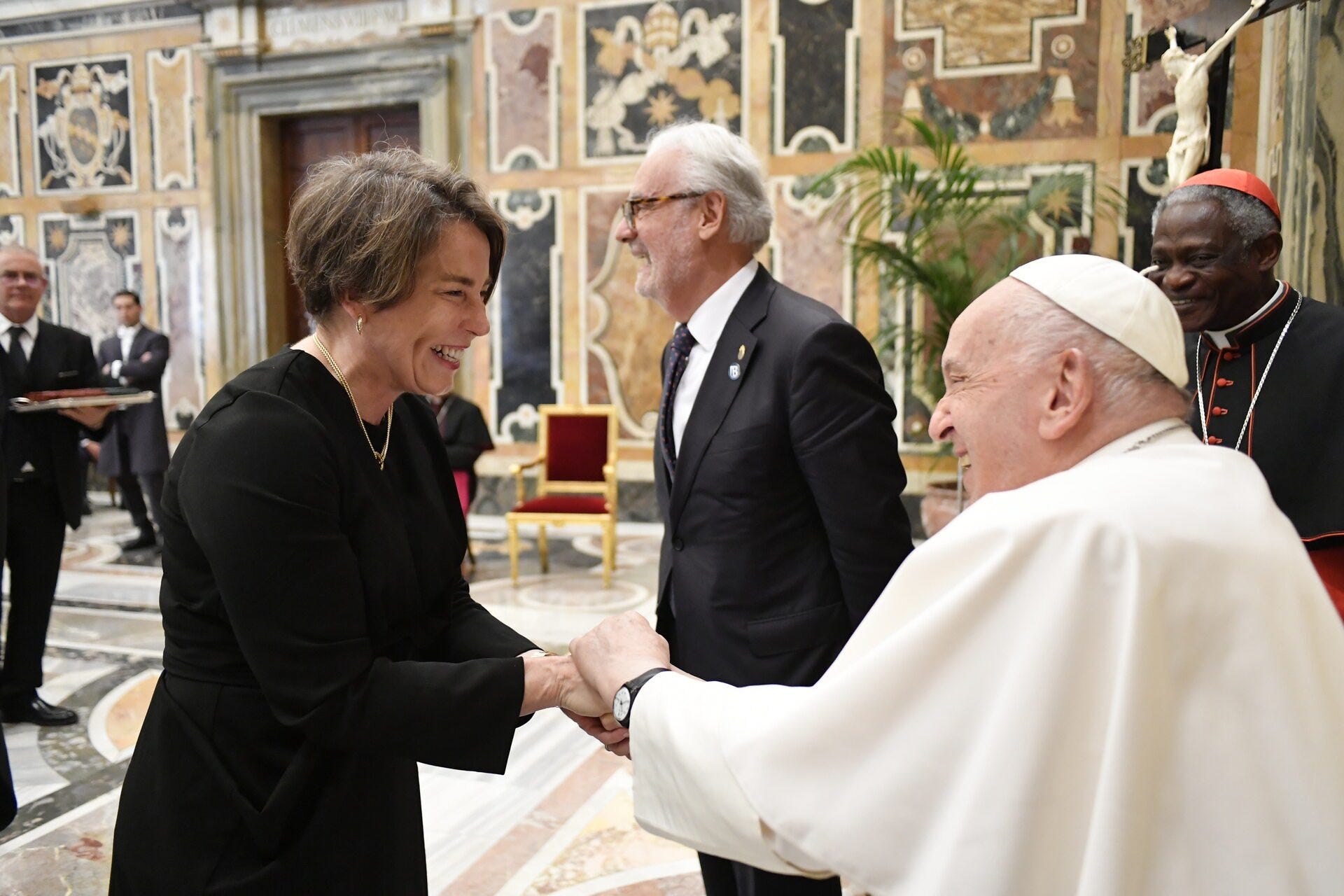
Healey, too, met with Pope Francis, in May 2024 while at the Vatican for a global climate change summit, where she delivered the opening day’s keynote address.
She left with a priceless gift from Francis for her mother, Tracy Healey-Beattie, a devout Catholic who attends Mass daily: rosary beads the pope had blessed, Politico reported at the time.
“As a Catholic, I think about what we were taught about making sure that we look after those around us — that we pay particular attention to those who are the most vulnerable among us,” Healey told the publication. “When it comes to climate, we know that it is the poor, it is people of color, it is low-income folks and marginalized communities that bear a disproportionate cost and burden.”
Healey acknowledged that her support for abortion rights and her position as one of the first two openly gay governors in the U.S. weren’t in keeping with Catholic teachings, but added: “It’s true that I’ve taken very strong positions when it comes to standing up for LGBTQ+ equality, to standing up for women’s access to reproductive health care, to supporting abortion rights in this country, and I believe very strongly in all of those. To me, it doesn’t make me any less of a Catholic or detract from my relationship to my faith.”
After Francis’ death in April of last year, Healey said “his essence of compassion, humility and unbounded hope gave us joy, peace, direction and resolve.”
“He strove to make the Church more inclusive and welcoming, and he led by reminding us of the dignity and worth of every person,” she said.
If you value independent Catholic journalism, please consider supporting The Catholic Observer through a paid subscription. Thanks for reading The Catholic Observer.